International Snacks Magazine learns how Reading Bakery Systems helped a Canadian bakery evolve from manual methods to automated production, positioning “Pasquale’s Glorious Flatbread” for wider commercial success
When Italian-born Pasquale Zappia and his wife Mayra opened Via Oliveto in Toronto in 1988, the business was a combination restaurant/bakery serving area hotels, restaurants and caterers. A baker by trade, Pasquale handled the bakery. His wife ran the restaurant, followed by their sons Patrick and Adriano when they were old enough. Pasquale had always put his own spin on Italian breadmaking, but when he began baking crispy artisanal flatbread crackers – essentially a European-style flatbread cracker – he truly found his niche.
As demand for the triangular flatbread spiked among their food service customers, it became Pasquale’s sole focus. In 2006, the family sold the restaurant, and the sons joined their father in the bakery as it relocated to a 2,000 square-foot facility in Toronto. In 2007, they started packaging the product for retail sales in a few local food shops and “Pasquale’s Glorious Flatbread” was born. Soon it was also selling in area supermarkets, and by 2009 Via Oliveto moved into an 8,000 square foot location in Vaughan, just north of Toronto.
The manual production process
To produce the flatbread, the family evolved a unique, labor intensive process involving convection baking in rack ovens. Their 24” wide system included a bowl mixer, a three-roll sheeter, three gauge rolls and 18” by 26” pans. Semi-automatic equipment sprayed the cut triangular pieces of dough with water, salt, seeds and herbs before the trays were manually placed into the rack ovens to bake, then manually removed to cool. This process included four double rack ovens with 32 aluminum racks and 2,500 baking pans, all of it handled by four people.
Production on this system peaked at about 100 kg per hour, and it made growing the bakery a challenge. In 2015, Patrick’s wife, Rachel, began managing the business and relieved much of the administrative pressure, but the production pain points remained. The Zappias knew they wanted to upgrade to a more automated, labor-saving solution, they just didn’t know how.
The family began reaching out to tunnel oven manufacturers in 2019 to explore their options. Their efforts included a trip to the International Baking Industry Exposition (IBIE) in Las Vegas, where they met more oven manufacturers and got system quotes. Some of those OEMs didn’t quite understand what the Zappias needed, and others proposed oven systems that were either too big, or too expensive. The family found the process overwhelming, but luckily, found their way to the RBS booth.
Meeting RBS at IBIE
The Zappias were struck by how confident RBS was that they could help Via Oliveto move from rack ovens to a tunnel oven system. “We thought, how could this be so easy for them?” recalls Patrick Zappia. “We thought it was going to be such a challenge but, RBS made it sound like the opposite.” The family was impressed by the company’s willingness to work with such a small bakery. They also liked that RBS, unlike some of their competitors, was proposing a one-stop-shop solution that featured an integrated sheeting line and oven, and the flexibility to produce new products in the future.
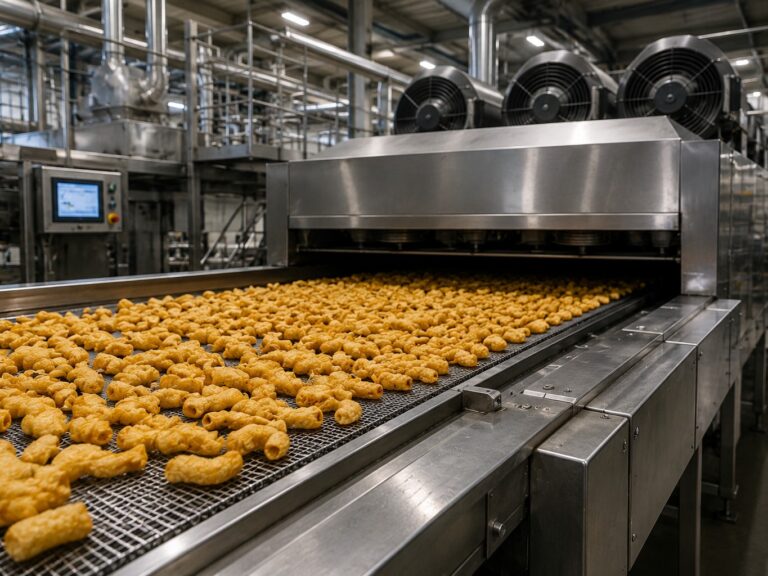
Eager to take the next step, the Zappias invited RBS to Via Oliveto to observe their production process and further assess their requirements. After seeing the family’s flatbread line in action, RBS technical sales reps proposed a configuration of the modular, fully automated Multi-Crisp Baked Snack System. The Zappias were impressed with the RBS visit and proposal but remained wary of making such a big move. To help allay their concerns, RBS invited the Zappias to the company’s Science & Innovation Center for a flatbread trial run.