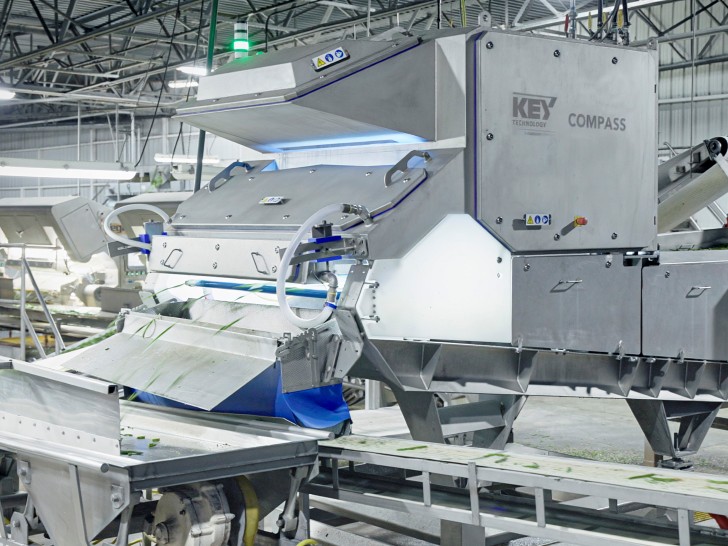

Key Technology has introduced three enhancements to its COMPASS belt-fed optical sorter, targeting inspection accuracy, product recovery and throughput in snack production.
The updates comprise pulsed LED backlighting, optional three-way sorting and a larger B200 model. The changes are intended to help processors manage product defects and foreign material while maintaining consistent output on demanding lines, including potato crisp production.
Improved Inspection and Separation
The new backlighting system uses visible and near-infrared wavelengths to transmit light through the conveyor belt. According to Key Technology, this can improve product identification and reduce interference from shadows or belt staining, issues associated with irregular products such as kettle-cooked crisps.
Optional three-way sorting introduces a second ejection manifold, allowing incoming material to be divided into three independently configurable streams in one pass. Operators can separate defect categories, create different product grades or recover suitable material for rework.
This could reduce reliance on a second sorter or manual inspection, depending on the line layout and requirements.
Higher Capacity for Snack Lines
The new COMPASS B200 features a two-metre-wide sorting belt designed for higher-throughput applications. For some processors, the wider configuration could replace multiple smaller machines, potentially simplifying installation and maintenance planning.
The platform retains recipe-driven controls, an open hygienic design and Key Discovery analytics software, which provides production data for monitoring sorting performance.
For snack manufacturers, the developments offer a choice of inspection and separation functions without necessarily adding standalone equipment. In particular, the ability to distinguish rejected material from products suitable for rework may support yield management and waste reduction.
However, equipment selection will still depend on individual product characteristics, defect tolerances, hygiene requirements and line capacity. Processors assessing the upgrades will need to establish whether the inspection improvements and additional sorting options justify investment within their existing operations.