

With certain products, food manufacturers can realise great benefits from using dual energy x-ray detection, especially when paired with advanced photon counting technology. Mike Pipe, Head of Product Inspection of Mettler-Toledo Product Inspection, explains how these technologies together can significantly improve both contaminant detection accuracy and overall business performance.
The detection of foreign body contaminants is part of the critical quality assurance process to improve food safety standards. X-ray inspection has long been a key technology in this process, but there are different types of x-ray detection with which food manufacturers can inspect their products, depending upon the nature of the application.
Traditionally, manufacturers have used single energy x-ray detectors, but dual energy technology is becoming more commonplace, and is more powerful, effective, and easy to use than ever before. It works using the concept of ‘material discrimination’, with dual x-ray beams of different energy able to identify materials of different densities. Advances in detection sensitivity mean that dual energy x-ray is now even more discerning, allowing ever-smaller contaminants to be detected in a wider range of applications.
Applications Suited to Dual Energy X-Ray
But what are the applications in which dual energy x-ray excels compared to the more commonplace single energy detection systems? In simple terms, there are two key aspects of a product that make it suitable for inspection by dual energy x-ray. The first is where there is a large degree of overlap within the package, or where there are variations in thickness. Examples of the types of packs where products overlap include packs of pasta, rice, nuts, and frozen goods such as French fries or potato wedges. Packs with variations in product thickness include chicken breasts and other fresh cuts of meat. Both scenarios produce an x-ray image with high levels of contrast.
The second type of application where dual energy x-ray is most suitable is where the likely contaminant in a food product is a low-density material, such as glass, plastic, rubber and calcified bone.
If a product application has one or both of these aspects, then a case can be made for dual energy x-ray. However, it is important to understand how this technology works. Here, the key concept is material discrimination.
How Dual Energy Works
Dual energy x-ray works by using high and low x-ray energy levels to discriminate between materials of different densities. A single generator produces the photon beam, which is then split into high and low energy levels either by a physical barrier before reaching the detector or electronically within the detector. This process allows the system to differentiate between the food product and any potential contaminants.
Rather than using machine learning, the system relies on proprietary software algorithms. These algorithms don’t just analyse the pixel’s grey level but instead assess the relationship between the grey levels of the same pixel in both the high and low energy images. This enables the system to remove the food product from the x-ray image, leaving behind any material identified by the second energy level, which is most likely a contaminant.
Photon Counting Technology
Photon counting represents a significant advancement in x-ray detection. A photon is a single particle of light, and in traditional silicon-based x-ray detectors, x-ray photons are initially converted into visible light by a phosphor screen. This visible light is then converted into an electrical signal by a silicon photodiode. While this process produces good x-ray images, some dispersion occurs during the light conversion, resulting in slightly “fuzzy” images.
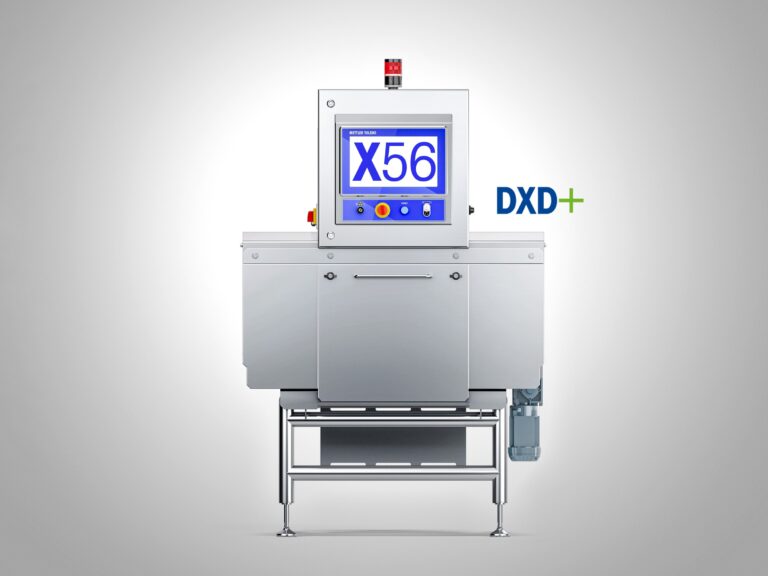
With photon counting in advanced systems like DXD+, x-ray photons are directly converted into electrical signals using cadmium telluride (CdTe) crystals. When a photon above the energy bandwidth interacts with the CdTe crystal, it excites an electron from the valence band to the conduction band, creating an electron-hole pair. The energy absorbed by the crystal determines the energy of the excited electron in the conduction band, which produces the electrical signal. This direct conversion method eliminates the intermediate step of converting x-ray photons to visible light, resulting in sharper images compared to silicon-based detectors.
In silicon-based dual energy detectors, the x-ray spectrum is split using a physical barrier, such as a copper filter in HiGain+ DE. However, in DXD+, the spectrum is split electrically, using the signal obtained from the CdTe crystal. This electrical splitting is more precise and consistent, leading to clearer images and better material discrimination.
Photon counting also allows for a sharper separation of low and high energy components, which enhances image resolution, particularly in products with overlapping materials. CdTe detectors have a faster response time due to higher charge mobility, but because of how photon counting technology is applied, these detectors may have a slightly lower maximum speed compared to silicon detectors.
Read more latest industry news and developments in our free to download magazine.
Never miss a story…follow us on:
LinkedIn: International Snacks
X: @IntSnacks
Media Contact
Joseph Clarke
Editor, International Snacks
Tel: +44 (0) 1622 823 920
Email: [email protected]